Del resto, o lettore, quivi avrai un giovinetto che, in via maravigliosa condotto alla fede di Cristo, in tenera età sigillò col proprio sangue la fede da poco tempo abbracciata.
Del resto, o lettore, quivi avrai un giovinetto che, in via maravigliosa condotto alla fede di Cristo, in tenera età sigillò col proprio sangue la fede da poco tempo abbracciata.
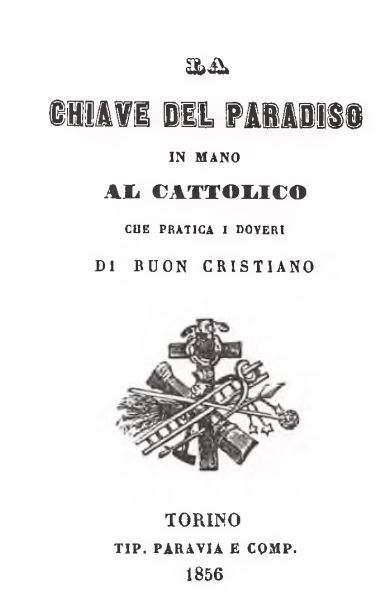
Questo libretto è intitolato la CHIAVE DEL PARADISO, perchè qualsiasi fedel cristiano che sappia, creda e pratichi quanto ivi si contiene può essere sicuro di sua eterna salvezza.
En una época donde la fidelidad al carisma pasaba por la imitación de la experiencia original del fundador, el director salesiano se concebía como el resultado de la universalización de la experiencia vivida por D. Bosco en el oratorio de Valdocco. Continue reading “Miguel Canino Zanoletty – “Las “pruebas” de D. Rua: la prohibición al superior salesiano de confesar a sus súbditos”, in “Don Michele Rua primo successore di Don Bosco. Tratti di personalità, governo e opere (1888-1910)”.”
Si riporta la bibliografia di riferimento per Storia e identità salesiana in Africa e Madagascar. Questioni di conservazione del patrimonio culturale.
Il Rettor Maggiore, don J. E.Vecchi, che già nel 1997 aveva sottolineato l’importanza della storiografia salesiana (lett. Io per voi studio, ACG 361), nel 1998 è ritornato sull’argomento.
The Rector Major, Fr J. E. Vecchi, had already in 1997 emphasized the importance of the study of salesian history (cf. Letter For you I study, AGC 361), and in 1998 he came back once more to the same argument.
Le Recteur Majeur, Père J. E. Vecchi, qui avait déjà en 1997 souligné l’importance de l’historiographie salésienne (lett. Io per voi studio, ACG 361), a insisté en 1998 sur le thème.
Durante il 1° Seminario Internazionale di Storia dell’Opera Salesiana per l’Africa e il Madagascar, svoltosi dall’11 al 14 ottobre 2011 a Karen (Nairobi – Kenya), si è potuto riflettere in modo particolare sulla questione legata alla produzione e alla conservazione della memoria salesiana. Si è constatato che nella cura degli Archivi ispettoriali (con poche eccezioni: come quello dell’Archivio ispettoriale dell’Africa Centrale) rimane assai da fare sia in riferimento al personale responsabile per tale settore della nostra congregazione sia in relazione allo stato di strutture che si dovrebbe mettere a disposizione per tutelare in modo conveniente la memoria dell’operato dei SDB. Si riscontra, piuttosto, una situazione allarmante che richiede interventi fatti in tempo debito, senza rimandi indeterminabili.
Durant le 1er séminaire international d’histoire de l’oeuvre Salésienne pour l’Afrique et Madagascar, qui a eu lieu du 11 au 14 octobre 2011 à Karen (Nairobi – Kenya), nous avons eu la possibilité de réfléchir spécialement sur les questions liées à la production et à la conservation de la mémoire salésienne. Il a été constaté qu’en ce qui concerne le soin des archives provinciales, (à part quelques exceptions comme celles des archives provinciales de l’Afrique Centrale) il reste beaucoup à faire, soit par rapport aux personnes responsables de ce secteur de notre congrégation, soit par rapport à l’état des structures nécessaires pour garder la mémoire de l’oeuvre des SDB de manière convenable. On rencontre plutôt une situation alarmante qui requiert des interventions avant qu’il ne soit trop tard, sans renvois indéterminés.
With this contribution the intention is, after a look at the ideological background to the “springtime of the writing of Salesian history”, to examine even briefly, our situation and relationship with the writing of Salesian history–to deal with the writing of history directly associated with the religious Institutes founded by Don Bosco, limiting myself however, to the Salesian Society.
During the 1st International Seminar on the History of Salesian Work in Africa and Madagascar, held between 11 and 14 October 2011 at Karen (Nairobi – Kenya), it was possible to reflect in a special way on the question of the production and the conservation of the Salesian memory. It was noted that in the care of the Provincial archives (with few exceptions: as for example that of the Provincial Archives of Central Africa) much remains to be done from both the point of view of the personnel responsible for this sector in our Congregation, and from the point of view of the state of the structures that need to be put in place to safeguard in the best way the memory of what the SDB have done. Rather there appears to be an alarming situation which requires something to be done quickly, without it being put off indefinitely.
Proudly powered by WordPress | Theme: Baskerville 2 by Anders Noren.