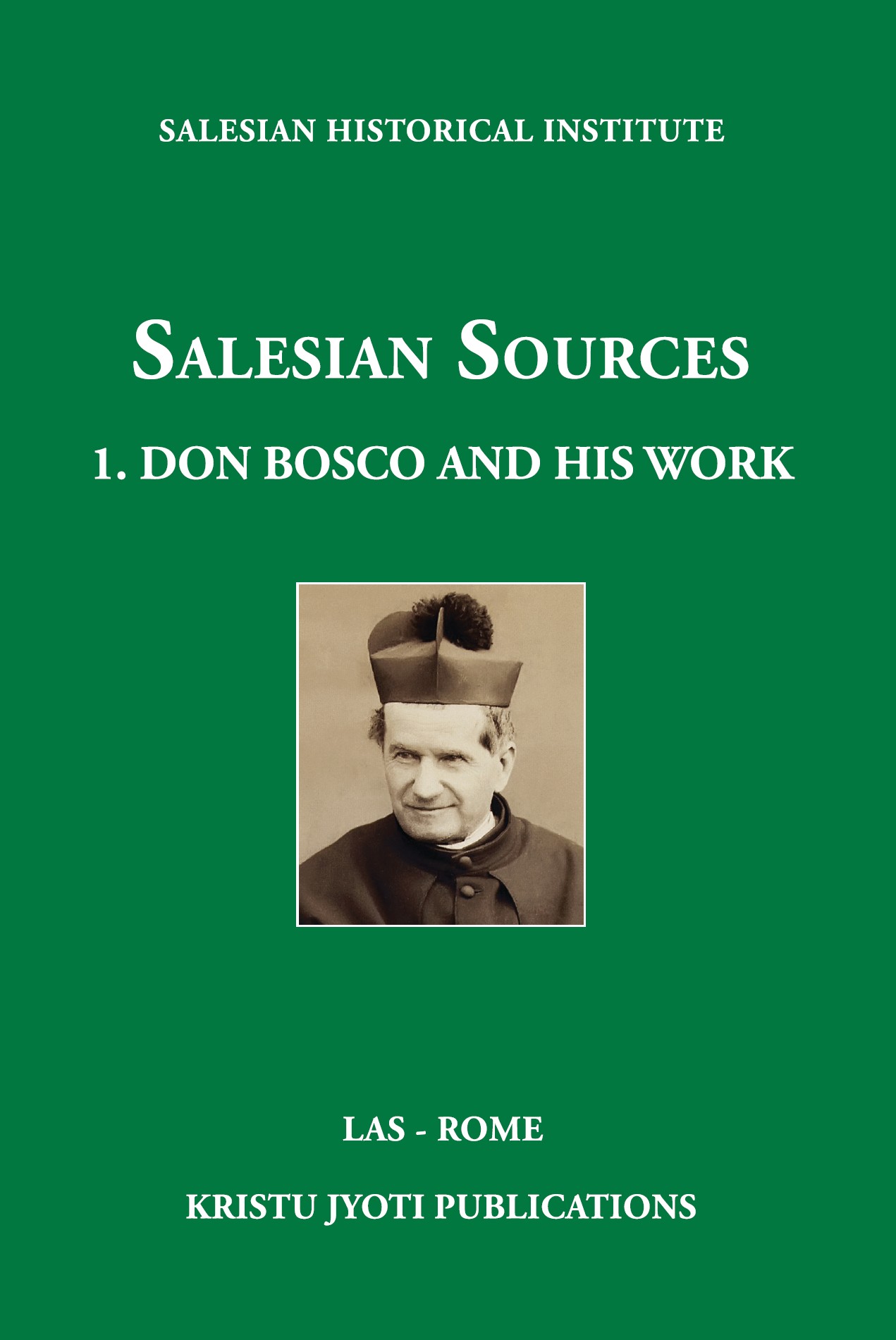
The first seven documents offered here belong in some way to the first missionary expedition which sailed from Genoa on November 14, 1875.
Continue reading “Giovanni Bosco – Sources prior to the first missionary expedition”
The first seven documents offered here belong in some way to the first missionary expedition which sailed from Genoa on November 14, 1875.
Continue reading “Giovanni Bosco – Sources prior to the first missionary expedition”
What were Don Bosco’s missionary plans for Argentina once he had set foot in that land? With the information in his possession thanks to research by Fr Giulio Barberis, and to correspondence with local authorities and Salesian missionaries, six months after the first expedition Don Bosco was able to send the Prefect of the Sacred Congregation of Propaganda Fide, Cardinal Alessandro Franchi, a first report on the immediate results of the work of Salesian missionaries in Argentina (no. 98). He asked for financial aid and the setting up of an Apostolic Prefecture for the territories of Pampa and Patagonia to refer those who belonged to no institution either ecclesiastical or civil.
Continue reading “Giovanni Bosco – A missionary project in rapid development”
Relationships between Don Bosco and Archbishop Gastaldi went through two different stages, one of great understanding and cooperation, and another of notable difficulties and conflicts. The watershed could be considered to be Gastaldi’s transferral from the Episcopal See of Saluzzo to being Archbishop of Turin in 1871.
Continue reading “Giovanni Bosco – Difficult relationships with the Archbishop of Turin”
One of the most difficult conflicts to resolve in relationships between the Holy
See and the new Kingdom of Italy was that of the dozens of Episcopal sees left vacant
for political reasons. Both parties were aware of the seriousness of the situation, but
attempts to exit from the situation were shipwrecked by the persistent serious friction
brought about by proclaiming a Kingdom which comprised territories taken from
the Papal States (1861). Only in 1865-1867 did a process of détente coming
into place, where, having overcome mutual resistance, the Holy See succeeded in
appointing many bishops with the agreement of authorities of the Kingdom.
The Law of Guarantees on 13 May 1871 and decrees applying to this required that for newly appointed bishops to enter into possession – the so-called temporalities – they had to present the Minister with the original decree of appointment and formally ask for the exequatur to be granted. This act, in the Holy See’s judgement, implied recognising the Kingdom of Italy which came into being in 1861, and included part of the Papal States ‘illegally’ taken from the Pontiff.
In the years immediately preceding and following Italian Unity (1858-1866), Don Bosco kept constantly in touch with Pius IX by letter. He did this not only for interests directly relating to his work, but also in reference to the worrying situation the Church was going through in Piedmont, to encourage him in his defence of the faith against the enemies of religion, and to pass on to him any likely reserved information in his possession. As already indicated, Don Bosco was with Pius IX and his Secretary of State, Card. Antonelli, on the Roman question. Slowly however, he became convinced that a too vigorous resistance to the “revolution” was becoming ever more pointless, even risked worsening the situation, so after the capture of Rome he chose, also politically, the principle of doing whatever good could be done.
On April 3, 1874, Pope Pius IX definitively approved the Constitutions of the Society of St Francis de Sales and on the following April 13 the competent Congregation of Bishops and Regulars promulgated the relevant decree.
Continue reading “Giovanni Bosco – Society of St Francis de Sales”
Don Bosco, at the advice of his spiritual director, St Joseph Cafasso from autumn 1844 to summer 1846 lived at the Barolo Refuge as chaplain of the Little Hospital of St Philomena, opened in August 1845. In the same place and in other temporary places not far from Valdocco, he carried out his early priestly ministry on behalf of boys, mostly immigrant lads who had no parish of reference. On the vigil of his move to the Pinardi house, he drew up for the civil authorities of the city of Turin, who were responsible for and concerned about public order, a very brief account of his three years of catechetical activity, indicating the aims and results he had achieved that were positive both for civil society and the Church (no. 1).
Lo studio che viene proposto prende in esame “quanto” e “come” la Congregazione salesiana, a partire dal Concilio Vaticano II a oggi, ha riflettuto sulla natura della sua missione educativa e pastorale tra i giovani. Punto di partenza di questa indagine è il CG19 celebratosi nella primavera del 1965 a lavori conciliari ancora in corso. Negli Atti del CG la Congregazione esprime in modo netto la propria identità educativa consolidata dalla tradizione salesiana e sintetizzabile nello slogan formare “buoni cristiani e onesti cittadini”. Continue reading “Sabino Frigato – Educazione ed evangelizzazione. La riflessione della Congregazione salesiana nel Postconcilio”
In a letter dated May 24, 1966, Fr. Luigi Ricceri (1901-1989), then Rector Major of the Salesian Society, introduced a new edition of the Constitutions to his confreres. Nearly one year had elapsed since the close of the nineteenth general chapter of the Salesian Society, and six months had passed since the close of Vatican II In this context, Fr. Ricceri introduced the constitutions which carried a number of changes that were to usher the Society toward its twentieth general chapter.
Continue reading “Joseph Boenzi – Chastity in the salesian constitutions”
The present article is not concerned with the new constitutions. No comparative study will be attempted, nor any reference will be made to them. This would be carrying coal to Newcastle. I shall instead attempt simply to identify and briefly discuss some of the spiritual insights and principles for religious life and action which Don Bosco embodied in his constitutions.
Proudly powered by WordPress | Theme: Baskerville 2 by Anders Noren.

