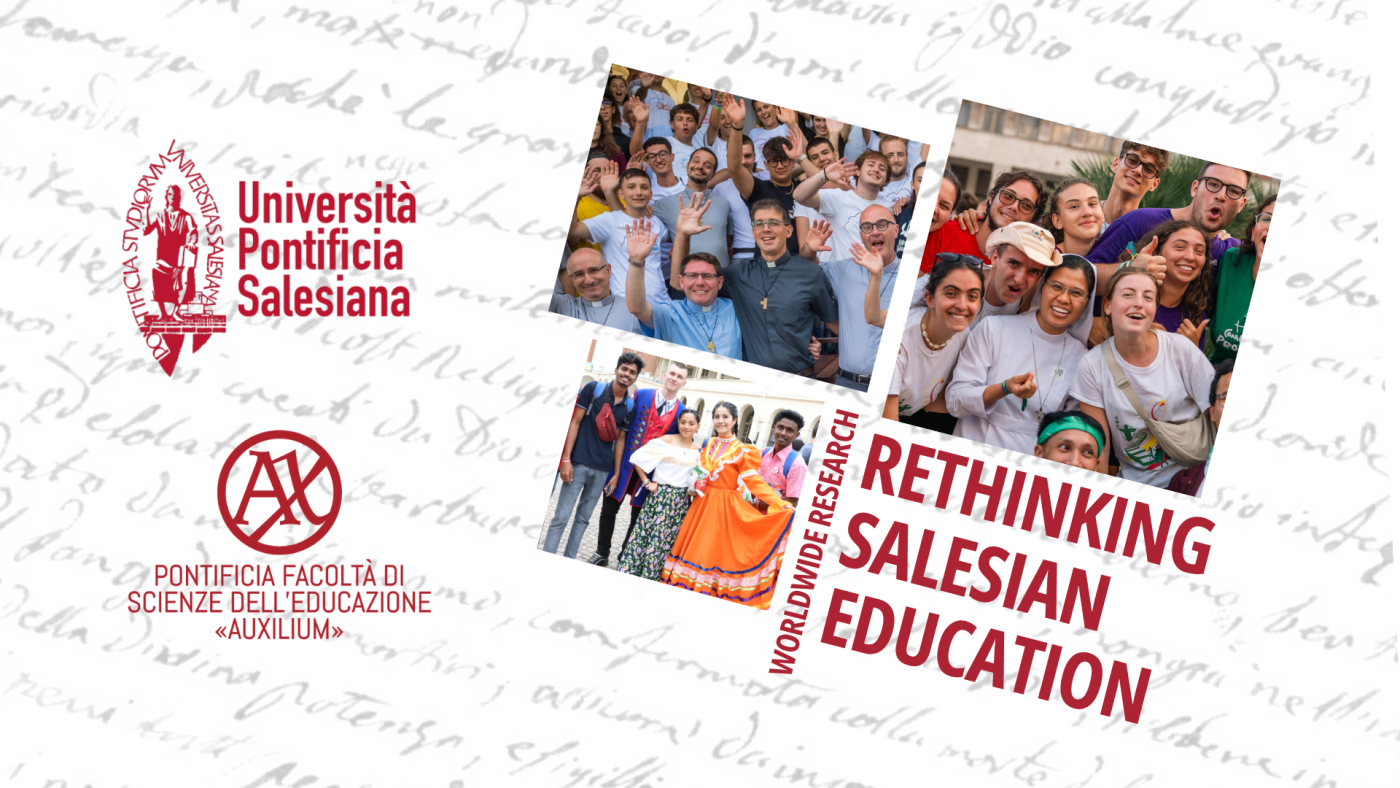
How has Don Bosco’s educational methodology evolved 150 years later across different parts of the world? Which values, practices, and educational languages continue to keep his original intuition alive? And how is this heritage expressed within diverse cultures and societies?
These questions gave rise to the international research project Rethinking Salesian Education (2025–2027). The project is promoted by the Pontifical Salesian University and the Pontifical Faculty of Educational Sciences Auxilium, in close collaboration with the General Councils of the Salesians of Don Bosco (SDB) and the Daughters of Mary Help of Christians (FMA). Its aim is to critically reinterpret and revitalize Salesian pedagogical thought at the level of the wider Salesian Family, in light of the intercultural and late-modern transformations shaping contemporary societies.
An Intercultural Theoretical Framework
The research is grounded in an intercultural theoretical framework inspired by leading scholars in value systems and cultural dimensions. Its purpose is to examine how key cultural factors—such as individualism versus collectivism, high-context versus low-context communication, hierarchical versus participatory leadership styles, and the integration of faith and culture—shape educational practice within Salesian institutions. In other words, the project seeks to understand how Don Bosco’s pedagogy is able to inculturate itself in diverse contexts, preserving its charismatic identity while taking on new, and often unexpected, forms.
The research design adopts a mixed-methods approach, combining quantitative and qualitative methods. It is structured around four main components, aimed at offering an integrated reading of educational complexity across different Salesian contexts worldwide.
Quantitative Research with Provincial Youth Ministry Teams (SDB and FMA)
Youth Ministry teams from across the world will participate in data collection through standardized questionnaires translated into multiple languages. The goal is to measure the values and cultural representations that shape the educational vision of Salesian leaders and decision-makers.
Quantitative Survey among Young People
Young people from Salesian schools, oratories, vocational training centers, universities, and social works will be involved in assessing the perceived impact of Salesian education on their personal development, value formation, life planning, and spiritual growth.
LINK TO THE “VADEMECUM FOR THE QUESTIONNAIRES” GUIDEBOOK
Qualitative research – Focus Groups
Focus groups will gather narratives from educational teams around the core themes of the Preventive System: trust in young people, the educational relationship, loving kindness (amorevolezza), and the role of the educator as guide and witness. These narratives will offer an “embodied” and context-sensitive perspective on lived pedagogical experiences across different educational settings.
LINK TO THE “VADEMECUM FOR THE FOCUS GROUPS” GUIDEBOOK
Documentary Analysis of Provincial Pastoral Projects
All strategic documents produced by Salesian provinces will be examined using thematic analysis tools. This will allow researchers to assess how Salesian values are translated into educational choices and programs, and to compare declared value orientations with those actually experienced within educational communities.

All collected data will feed into a global comparative analysis. Quantitative tools will highlight similarities and differences across geographical and cultural areas, while qualitative data will provide deeper interpretative insights. This integrated perspective will make it possible to identify effective educational strategies and recognize good practices that may inspire other Salesian contexts worldwide.
Educating between Culture and Charism
Rethinking Salesian Education is not merely an academic research project. It is also an opportunity to listen to the voices of young people and educators who embody Don Bosco’s legacy every day in widely differing contexts. Through dialogue among people, cultures, and experiences, the Preventive System can be renewed as a universal pedagogy of hope—capable of forming “good Christians and honest citizens” in every part of the world.
Contact: salesianedu@unisal.it